


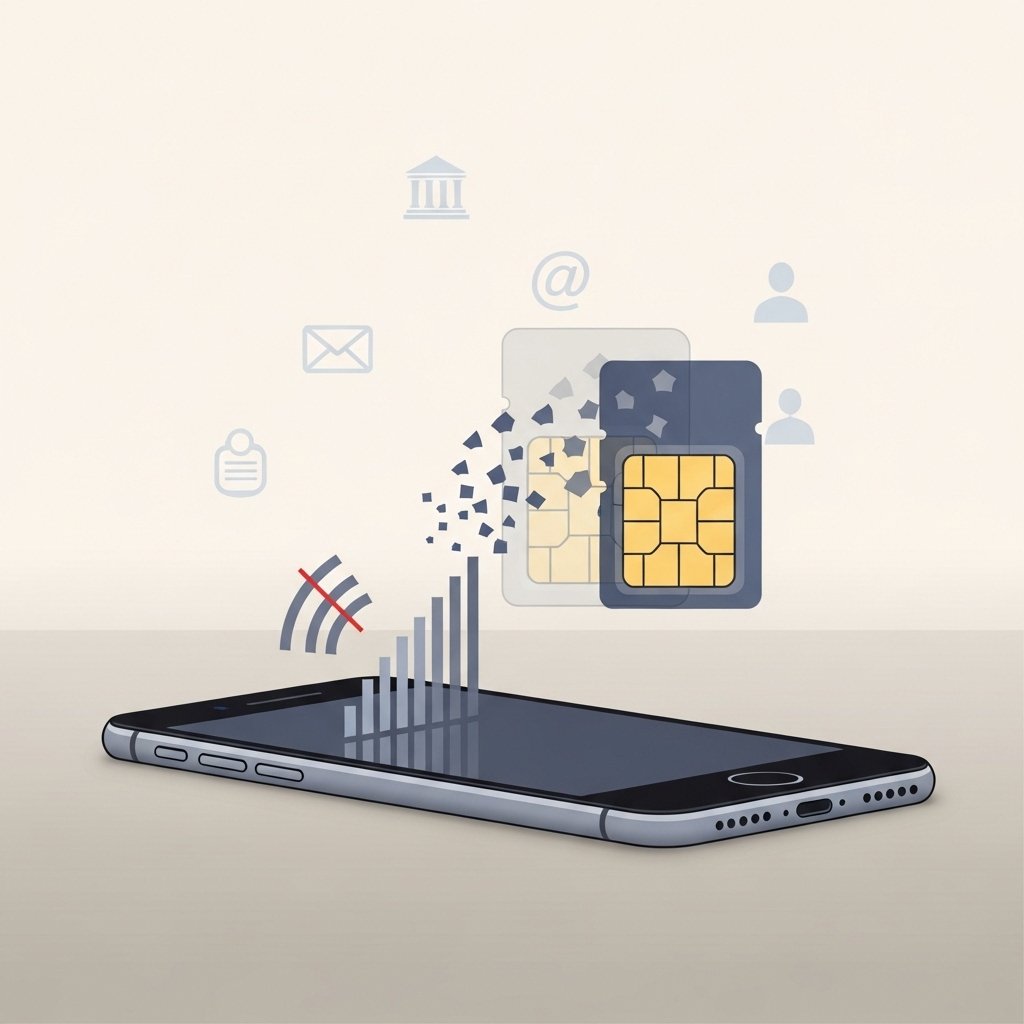
Your phone number is more powerful than most people realize.
It is used to receive banking alerts, password reset links, authentication codes, and account recovery messages. If a criminal takes control of your phone number, they can intercept those codes and access your accounts.
This type of attack is known as a SIM swap.
Recognizing the warning signs early can prevent serious financial damage.
What Is a SIM Swap?
A SIM swap happens when a fraudster convinces your mobile carrier to transfer your phone number to a new SIM card under their control.
Once the transfer is complete:
Your phone loses service.
The attacker receives your calls and text messages.
Verification codes are redirected.
Password resets become possible.
The goal is usually to access:
Bank accounts
Crypto wallets
Email accounts
Social media profiles
Early Warning Signs
Sudden Loss of Signal
If your phone suddenly shows:
No service
Emergency calls only
No signal bars
And it does not resolve after restarting your device, this may be a sign your number was transferred.
Unexpected signal loss is often the first indicator.
You Stop Receiving Text Messages
If you are expecting messages and they never arrive, especially verification codes, that is suspicious.
SIM swap attacks often begin silently before financial activity appears.
Unfamiliar Account Notifications
You receive emails stating:
Your password was changed
Two factor authentication was disabled
A new device logged in
If you did not request these changes, act immediately.
Carrier Account Changes
You receive notifications about:
SIM card activation
Device changes
Account modifications
Without your authorization, this is a strong red flag.
Locked Out of Important Accounts
If you are suddenly unable to log in and password resets fail because codes are not reaching your phone, a SIM swap may already be in progress.
How SIM Swaps Happen
Fraudsters gather personal data through:
Data breaches
Phishing attacks
Social engineering
Public social media information
They then contact your mobile carrier pretending to be you.
If they provide enough personal details, the carrier may transfer your number.
What To Do Immediately
If you suspect a SIM swap:
Call your mobile carrier from another phone.
Request immediate suspension of your number transfer.
Change passwords on critical accounts.
Enable authentication app based MFA instead of SMS.
Contact your bank and financial institutions.
Speed is critical.
How to Protect Yourself
Use authentication apps instead of SMS when possible.
Set up a PIN or passcode with your mobile carrier.
Limit personal information shared publicly.
Monitor account login alerts.
Avoid sharing verification codes.
Your phone number should not be your only layer of security.
Why SMS Based Authentication Is Risky
SMS verification is better than no protection, but it is vulnerable to SIM swap attacks.
If possible, switch to:
Authentication apps
Hardware security keys
App based push approvals
Reducing reliance on SMS reduces exposure.
Final Thoughts
A SIM swap can happen quietly and escalate quickly.
The first warning is often signal loss. The second is account compromise.
If your phone suddenly stops working without explanation, treat it as urgent.
Protect your mobile account.
Strengthen authentication methods.
Act immediately if something feels wrong.
Your phone number controls more than calls and texts. It protects your digital identity.